
Today, I’m delighted to be sharing a really insightful and poignant conversation with Sara Barnard, author of Where The Light Goes. This was such a profoundly moving book that really hit home for me. Thank you so much to Kirsten Cozens at Walker Books for facilitating this.
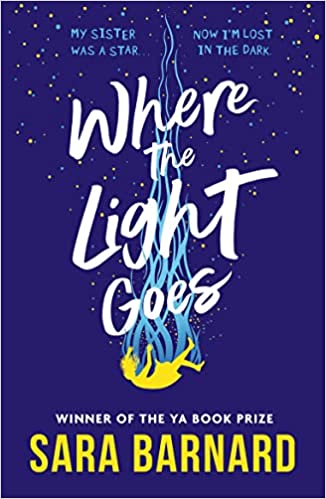
To the world, Lizzie Beck is a superstar: famous, talented and beloved.
To Emmy, she is simply Beth: her brilliant older sister, her idol.
But then Beth takes her own life, and all the light in the world disappears.
Now Emmy is lost. Amidst the media storm and overwhelming public grief, she must fight to save her own memories of her sister – and find out who she is without her.
TW: death, grief, death by suicide, suicidal ideation, drug use, addiction, impulsive behaviour
Emily: Firstly, thank you so much for joining me today! Please could you give us a brief summary of Where The Light Goes?
Sara: Thank you for having me! Where the Light Goes is the story of Emmy, who has just lost her extremely famous and much loved older sister Beth to suicide. Emmy is trying to deal with her personal grief for her sister while also trying to understand all the public mourning from the press and people on social media, who were never kind to her sister when she was alive. It’s a lot.
This is a heavy book that delves into death by suicide and the impact on those bereaved by suicide. What research did you do to ensure you had such a sensitive and nuanced portrayal?
I always start with the characters and go from there. If you lead with their emotions, and try to capture them authentically and without judgement, that will naturally create a nuanced portrayal of something real, however difficult it is. It’s when you try and fit a character and their emotions into a particular box that you’re going to run into problems. I’ve unfortunately experienced bereavement by suicide myself, so I had a lot of my own emotions to process, and writing this book did help with that. I’ve been a support volunteer with the Samaritans for several years, so that helped a lot as well.
I spoke with the Samaritans Media Advisory service before the book was published, and they read it and were able to offer some advice.
I really appreciated the list of resources you included in the back of the book and the suggestion of self-care. What’s some of your favourite self-care activities?
I think acts of self-care are primarily about compassion, except taking the time to show it to yourself as well as to others. Sometimes that’s an easy thing to forget, that you also deserve your own kindness. I’m not really one for long baths or scented candles, or walking or painting or anything else like that. Music is always my number one go-to. I have to have headphones with me at all times.
I loved Where The Light Goes for its raw emotional intensity and stunning depiction of grief. Would you mind expanding on what drew you to writing about these themes?
Thank you! It was my own experience that created the sense in me of needing to write about it. It took a few years to get to the point where I could write about it in the way that was right for this book. Grief is such an intense and relentless thing – you have all of these emotions and really nowhere for them to go. I tend to process my own emotions and experiences through fiction, so that’s what happened here in a lot of ways. I wanted to create as authentic an experience of immediate and intense grief as possible, without sanitising it. Grief is so violent and ugly in a lot of ways – it isn’t just weeping quietly in a room, at least not all the time; I didn’t want to shy away from that. I think young readers especially deserve to read the truth of it; I think they need it. I know I did when I was that age.
Fame and its dark side, particularly media scrutiny and impact on mental health, feature heavily in this book. How do you think the boom around virality and short-lived fame or infamy is impacting today’s young people?
I think that social media was supposed to make people feel closer and more real, but actually, in a lot of ways, it’s had the opposite effect. People don’t see famous people as real people, and that can be a dangerous thing. If you’ve only seen someone through a screen, you don’t know them. I find it quite scary how young people who have grown up with this reality are often unaware of that fact. Before social media, we wanted to consume famous people; we wanted to know everything about them – that hasn’t changed – but we didn’t think we actually knew them. A lot of toxicity comes
with that belief. And I’m not just talking about fans, either. It’s often the case whether the person in question is loved or hated, and it can be dangerous either way.
Music plays a massive role in the story. Aside from the featured songs in the book, what music would be on your Where The Light Goes soundtrack?
There’s a song by Kina Grannis called ‘Beth’ that I listened to a lot – that would definitely be at the top of the list. Counting Crows’ ‘Goodnight Elisabeth’ would be on there too – I think that’s a song the girls’ dad would have listened to, and probably sung to Beth as a child. The song Emmy chooses for the funeral, ‘Halo’, would be on there. (The Texas song!) Also ‘Wish You Well’ by Katie Herzig. And of course ‘Emmylou’, by First Aid Kit.
Do you have any dream castings for a film or TV adaptation of Where The Light Goes?
Honestly, no, my brain just doesn’t work that way! I always feel like that’s a boring answer, but it’s the truth! Any film or TV adaptation that had a casting of any kind would be a dream, to be honest. I’d love to see these characters come to life.
Finally, what message would you like Where The Light Goes to leave with readers?
That no love is ever lost or wasted. In the end, it really is the only thing that matters.

 A Short Book Lover
One thought on “Q and A: Sara Barnard, Author of Where The Light Goes”